
KFARM EDUCATION BOOK / READ THE LAND
Read the Land Before You Place Anything Permanent
Observe water, slope, sun, shade, access and fixed systems before turning a blank property into permanent zones.

FIELD GUIDE
Observe Before You Assign Uses
The land already has patterns. Water moves, shade changes, access has limits and fixed infrastructure creates boundaries.
FIELD CHECK
Walk after rain · mark high and low ground · observe sun and shade · trace access · photograph wet areas.
FIELD GUIDE
Map the Constraints
Septic, utilities, drainage, mature trees and access routes need their own layer on the working map.

Record What You See
Read details
What did you see, where and when?
Confirm with Reliable Records
Read details
Which record or source verifies it?

List What Needs Checking
Read details
What needs another visit or qualified check?
FIELD GUIDE
Turn Observation Into a Working Map
Mark what is confirmed, observed and still needs verification.
FIELD NOTE
A useful map can contain unknowns. Mark them clearly instead of making assumptions permanent.
Field record
Trace five rainwater paths and download the printable field record.
FIELD GUIDE
Your working sheet
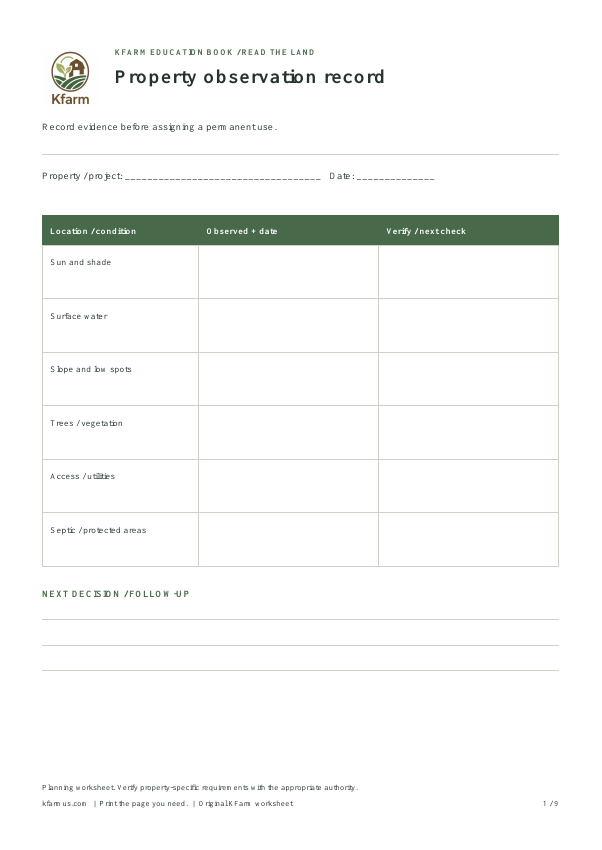
Property observation record
A real working sheet for your property. Record evidence, assign the next action and set a follow-up date.
Free nine-page PDF. Print page 1 for this chapter.
Download free workbookSelect the preview to view the full-size sheet.
Tools for This Plan
Rain gauge. Record rainfall beside your notes on puddles and runoff. A simple rain gauge helps compare visits, but it does not determine drainage design or soil infiltration capacity.
Outdoor temperature monitor. Place a suitable outdoor sensor where it reflects the conditions you need to observe. Read it alongside animal behavior and site conditions rather than relying on one number alone.